
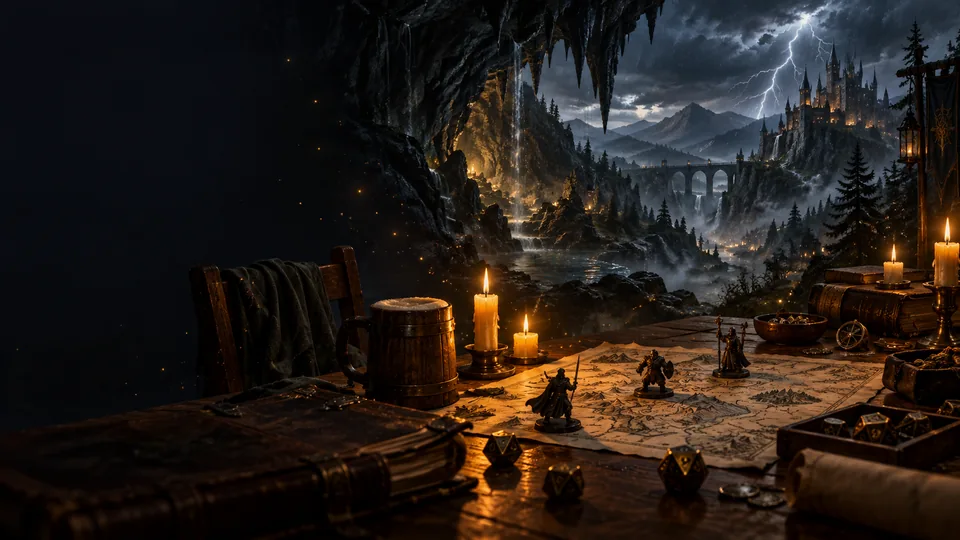
How it works — ninety seconds: build an environment, tap a board, save the scene. Step-by-step guides and the rest of the videos are in the docs.
- 119 environments in 16 families
- 67 sound boards
- 1839 sound clips
- up to 12 layers per scene
- free, no account needed
- browser & Android
Most sounds have several takes, so a button never repeats the same one. Works on a phone at the table and a laptop at home — sign in with an email to keep everything on every device.
Environments — generative ambience
Layers that build a place out of sound. Every layer is one sound from the library: a loop that plays the whole time — rain, a drone, a crowd — and a random sound that drops in now and then: drips, footsteps, a scream every minute or so. Dials for how often, how far away, how much room. It all changes live, and it never loops the same way twice.
Boards — a soundboard for the GM
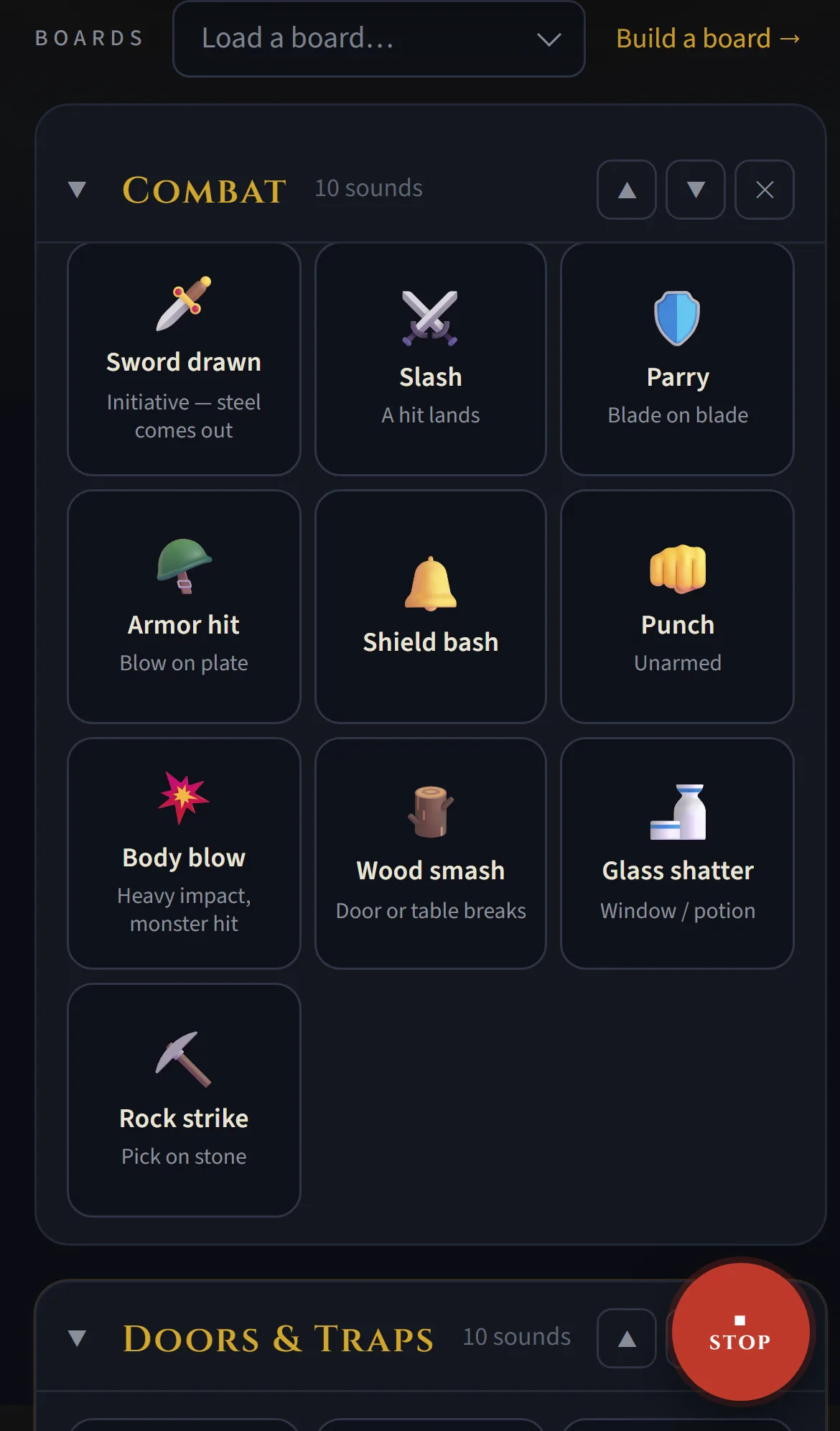
Grids of big buttons for the moments: sword hits, doors, spells, alarms. Build your own from the library — name each button, add a note only you see, choose which takes it uses — or start from the built-ins, including a board for every class from Barbarian to Wizard. Buttons can loop until you tap them again.
Scenes — one tap brings it back
An environment plus the boards that go with it, saved as one thing: the goblin warrens, the tavern, the boss fight. Tap a scene and it all comes up — the boards load, the sound crossfades, and the environment starts on its own. Make as many as your night needs, and switch between them mid-session.
Environments you can build tonight
Every one of these is a few layers from the library. Start from a built-in, or from nothing.
- Cave ambience — dripping water, resonant drips with echo, cavern rumble, a deep cave wind.
- Dungeon ambience — a dark drone, chains dragged somewhere, prisoners moaning, a cell door, distant screams.
- Prison block — hall voices, chain clinks, iron doors, a whip.
- Castle and keep — footsteps on stone, doors and latches, a bell, a fire in the grate.
- Tavern — coins on the bar, glasses, voices down the hall, a crowd that swells and settles.
- Storm and weather — light or heavy rain, rain on a roof, wind in the trees, thunder near or distant, a howling winter storm.
- Forest, meadow and lake — birds, crickets, a campfire, waves lapping, wind on the mountain.
- Battlefield — a war drone, an army marching, horns, the mob waking up.
- Haunted corridor — creaking wood, wails and cries far off, a door that shouldn't open.
Made for the table
- Phone-first at the table. Three buttons across, a stop button under your thumb, layers that collapse to a line.
- Sounds are ready before you need them. Whatever is in play is loaded in the background, so the first tap is instant.
- Your library, your names. Rename any button, keep only the takes you like, put a sound on as many boards as you want.
- An account is optional. Everything works signed out. Sign in with an email and a link — no password — to sync environments, boards and scenes across devices.
Works with any tabletop RPG
Thaumaturgy is about the place, not the rules. Game masters use it for Dungeons & Dragons (5e and older editions), Pathfinder, Call of Cthulhu, Daggerheart, Shadowdark, Blades in the Dark, Savage Worlds, Warhammer Fantasy Roleplay, Vampire: The Masquerade, Mörk Borg, Old-School Essentials, Dungeon World, Cyberpunk RED, Fate and GURPS — a dripping cave sounds the same in all of them. Horror tables lean on the haunted and dungeon families; sci-fi and modern tables on weather, crowds and the boards.
How to use it at the table
Short walkthroughs for the things game masters actually ask — what to play, how loud, and how to build a place from scratch.
- How to play D&D online with shared soundWhat a broadcast carries and what it does not, what your players need at their end (a link, and nothing else), and what to do when one of them hears silence.
- How to add ambient sound to a D&D gameHow loud a bed should sit, how many layers is too many, what the Distance readout words mean, and when to cut the sound dead instead of playing something.
- How to build a tavern soundscapeThe built-in Tavern's six layers with their real volumes, distances and cadences, what to change in them, and how to make the same room turn hostile.
- How to build a dungeon soundscapeThe built-in Mountain Cave's five layers with their real settings, why the drips never repeat, and how to make a dungeon worse as the party goes deeper.
- How to run sound during combatThe built-in Combat board's ten buttons and their takes, which of the three volume controls to reach for, and how to swap boards without leaving the scene.
- How to run game sound from your phoneWhere every control sits in the phone layout, whether sound survives a locked screen, the iPhone first-tap rule, and what an account actually buys you.
- How to build a D&D soundboardWhich sounds belong on a button and which belong in the environment, how takes and the Level slider work, and why a board is built before the session.
- How to run a session with scenesPlan a night as a handful of places, save each as a scene, and run the game by tapping them — and what to do when the party goes somewhere else.
- YouTube ambience for D&D gamesYou can run a game off a loop video, and sometimes you should. What one cannot do — a sound on cue, two distances — and how to rebuild the ones you reuse.
- Ambient sound for Pathfinder and other RPGsNothing in the library is tied to a rules system. Which environments carry over to horror, modern and sci-fi tables, and where your own audio fills the gap.
The sound of a particular place
Each one is the built-in environment taken apart — every layer, with the real volume, distance and cadence it ships with — so you can play it as it is or rebuild it to taste.
- Cave ambience for D&DA cave is one quiet air loop and resonant drips every four seconds.
- Tavern ambience for D&DA tavern is a crowd loop at 60%, a hearth under it, and mugs every eight seconds.
- Dungeon ambience for D&DA dungeon is iron at three distances over a bed that already has voices in it.
- Forest ambience for D&DDaytime woodland: a leaf bed, birds every five seconds, and a branch snapping once a minute.
- Rain and thunder ambienceThe built-in storm is two loops and one scheduled layer.
- Battlefield ambience for D&DA battle is almost entirely far away: a distant roar, steel every three seconds, and shouts close by.
- Haunted house ambienceThe haunted corridor runs the highest wander in the whole library — 90%.
- Underdark ambience for D&DSeven layers, two of them loops, and drums at the edge of hearing.
- Castle ambience for D&DA great hall is a hearth, a tight room on the bed, and footsteps carrying from far away.
- Campfire ambience for D&DThree loops, embers every six seconds, and a wolf twice an hour.
- Ship at sea ambienceA ship is a structure under load: hull every five seconds, rigging every eight, and a bell twice an hour.
- Desert ambience for D&DFour layers and a vulture: the smallest environment of these fifteen, and why an honest desert is a scene-length tool, not a session one.
- Swamp ambience for D&DFrogs every six seconds, mud every ten, and something large every eighty.
- Crypt and tomb ambienceEvery event layer in a crypt carries a large room.
- Medieval market ambienceA market is a crowd with work in it: coins nearby every fifteen seconds, carts and chickens further off.
How it compares
What the other tabletop audio apps do, what they cost, and which ones you can record and stream without a credit or a license — checked against each maker’s own pages.
- Thaumaturgy vs SyrinscapeSyrinscape has licensed adventures and music and costs $8.50 a month. Thaumaturgy is free, builds environments live, and has no music.
- Thaumaturgy vs Tabletop AudioBoth are free and run in a browser. Tabletop Audio has 500 composed ambiences; Thaumaturgy takes environments apart into layers you tune live.
- Free D&D ambience apps comparedTen tabletop audio apps: prices, platforms, sound effects, and which ones you can record and stream without a credit. Checked on the makers' own pages.
- RPG soundboard alternativesSix soundboards for tabletop games: which come with sound effects, which take your own audio files, which run on a phone, and what each one costs.
Questions
Is it really free?
Yes. The app, the sound library and accounts are free. The sounds are public-domain recordings and audio made for Thaumaturgy. Nothing in the library needs crediting and there is nothing to attribute.
Do I need to download anything?
No. It runs in the browser on a phone, tablet or laptop. On iPhone the first sound needs a tap — pressing PLAY or a scene counts.
Can I use my own sounds?
The environment and boards use the built-in library. There's also a "Your own sounds" section where you can add your own MP3, OGG, WAV or FLAC and use it on a board or under a scene. Signed out it stays on your device; signed in it is kept in your account so it follows you between devices, and your players hear it when you play it.
Why is it called Thaumaturgy?
Thaumaturgy is a cantrip in fifth-edition D&D for small magical effects — a booming voice, flickering flames, a door slamming on its own. It seemed like the right name for something that does the same job for a game's atmosphere. The app itself is ordinary software: an audio player for tabletop RPG sessions, free in the browser and on Android.
What systems is it for?
Any tabletop RPG — D&D, Pathfinder, Call of Cthulhu, Daggerheart, Shadowdark, Blades in the Dark, Savage Worlds, Warhammer Fantasy Roleplay, Vampire: The Masquerade, Mörk Borg, Old-School Essentials and the rest. Nothing in it is tied to a rules system; it's the sound of the place, not the mechanics.